


The first Smith & Wesson revolvers marked a milestone in 19th-century weaponry history by successfully market the metallic cartridge. This technological evolution forever transformed firearm design. Today, these pieces are the center of attention for collectors seeking authentic replica revolvers to decorate and preserve this legacy of the Wild West.
The Smith & Wesson Model 1: The Metallic Cartridge Revolution
Introduced in 1857, it was the first firearm marketed by the company and an absolute revolution for its time. Its great innovation lay in Rollin White's patent, which allowed the manufacture of cylinders bored completely through to insert breech-loading cartridges.
Featuring a single-action mechanism and a tip-up barrel, this model used the .22 Short (Rimfire) cartridge, considered the world's first successful black powder metallic cartridge. By leaving behind the old black powder and percussion cap muzzle-loading systems, the Model 1 became immensely popular as a secondary personal defense piece among soldiers during the American Civil War.
The Smith & Wesson Model 2 Army and its Impact on the Civil War
To meet the demand for a larger caliber during the American Civil War, the company introduced the Model 2 Army in 1861. This enlarged version maintained the successful tip-up design, but was chambered for a more impactful .32 caliber.
In addition to a larger caliber, the cylinder had a 6-cartridge capacity. Its mechanical reliability made it one of the weapons commonly carried by iconic historical figures of the Old West, such as the legendary Wild Bill Hickok.
The Smith & Wesson Model 3. What Technological Innovations Did It Introduce?
In 1869, the industry experienced a definitive qualitative leap with the Model 3. Compared to the solid-frame revolvers of the time, which required extracting empty shells manually one by one, this piece offered a huge tactical and operational advantage.
The "Top-Break" System and Simultaneous Extraction
The Model 3 introduced a hinged frame that opened downward (top-break). When fully opened, an automatic extraction system simultaneously ejected all empty shells, drastically speeding up reloading.
Initially designed for the powerful .44 American caliber, this revolver attracted international attention. The prestige of its mechanics led to famous commissions, such as the Russian model, designed to precise specifications for the armed forces of the Russian Empire.
Comparison of Early Smith & Wesson Models
To understand at a glance how the American firm revolutionized the weaponry industry in just a couple of decades, below we detail the technical evolution of its early designs. This progression highlights the rapid leap from small personal defense calibers to the robust simultaneous extraction mechanisms adopted by the cavalry.
| Model | Year of Introduction | Opening Mechanism | Original Caliber | Main Historical Milestone |
|---|---|---|---|---|
| S&W Model 1 | 1857 | Tip-up | .22 Short (Rimfire) | First successful metallic cartridge |
| S&W Model 2 Army | 1861 | Tip-up | .32 Rimfire | Secondary weapon in the Civil War |
| S&W Model 3 | 1869 | Top-break | .44 American | Simultaneous shell extraction |
The Birth of the Legendary Schofield Revolver and Wild West Outlaws
Despite the success of the Model 3, the design needed to adapt to the demands of horseback combat for the US Cavalry. In 1875, Major George W. Schofield proposed a series of brilliant modifications to the latch system, moving the spring-loaded barrel catch directly to the frame.
This improvement allowed a rider to open the weapon with one hand, eject the cartridges, and reload in record time. The United States government ordered thousands of units to equip its troops during the Indian Wars. However, its fame transcended the military: the Wells Fargo company adopted it as the standard weapon for its agents, as well as famous outlaws like Jesse James.
That is the full history of the Schofield revolver.
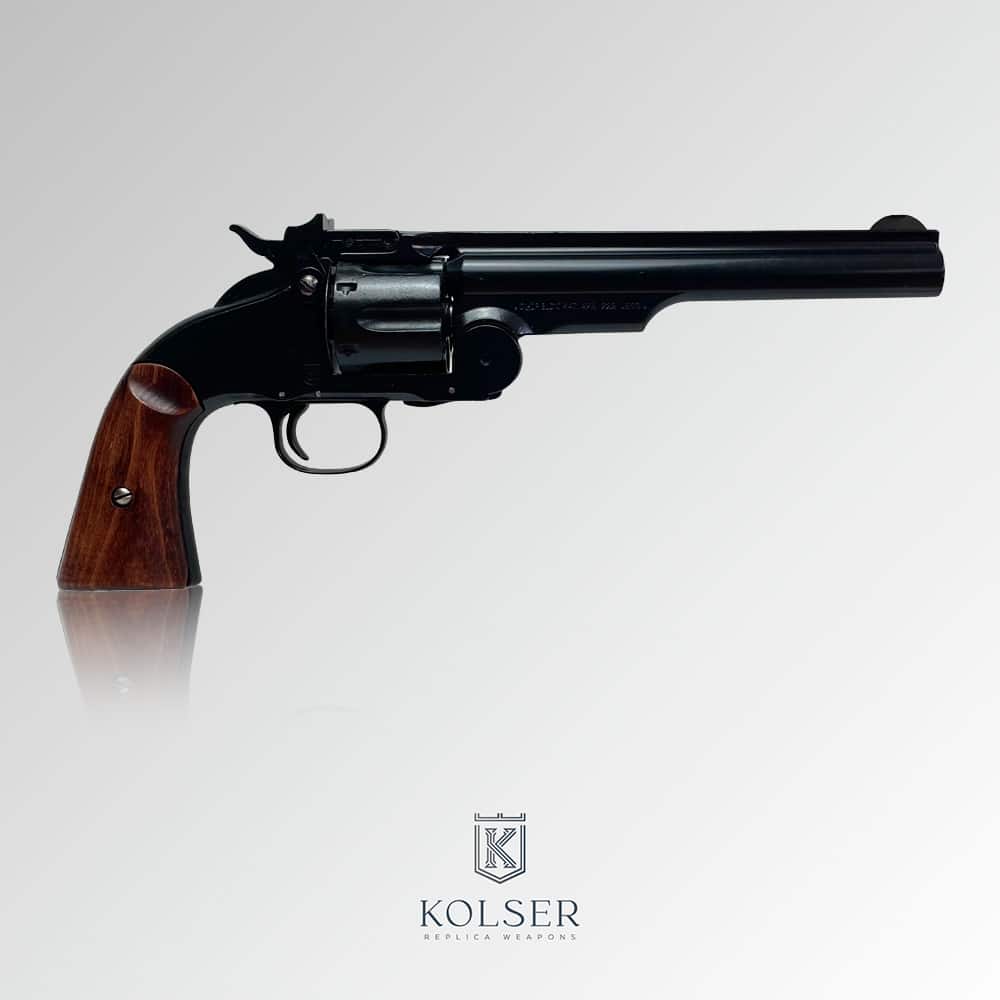

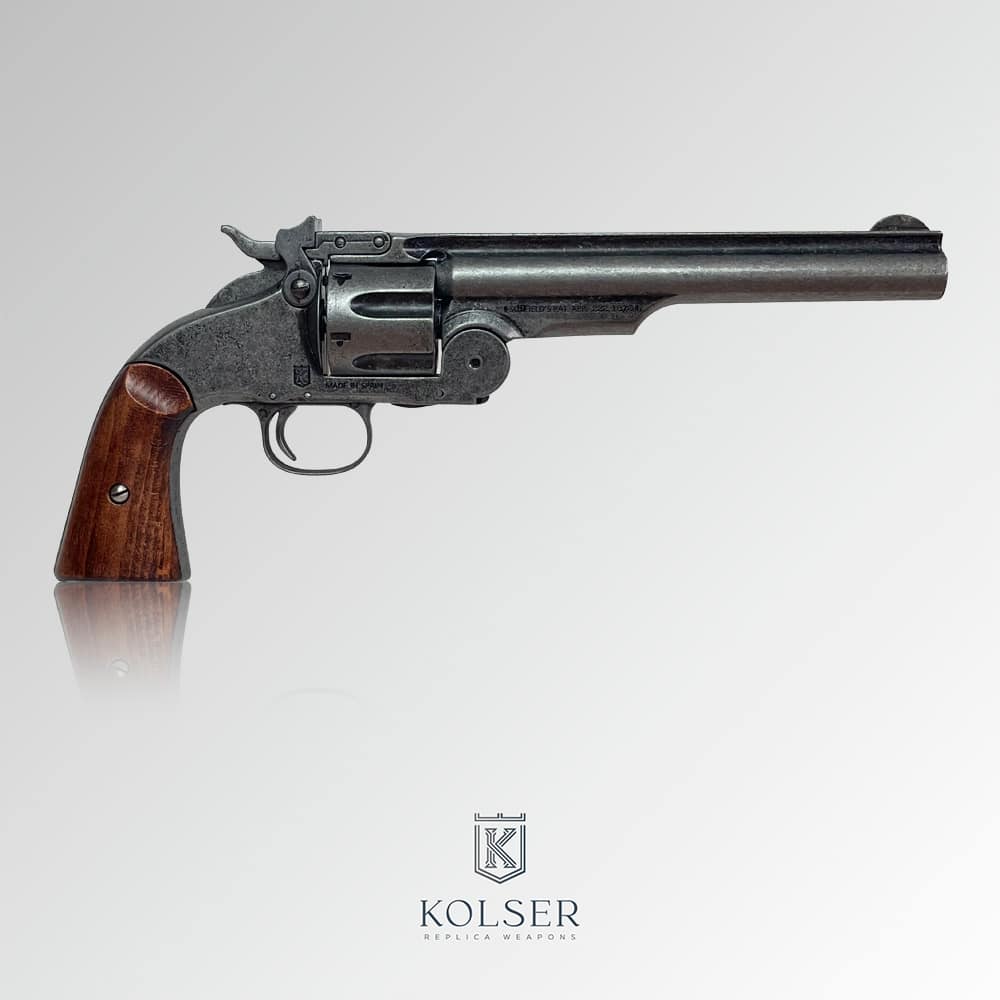
Delve into the legend: If you are passionate about the golden age of the frontier, we invite you to explore our documentary selection on the best Wild West revolvers and their impact on history.
Preserve History: Western Revolver Replicas for Collectors
Today, the value of the early Smith & Wesson models lies in their enormous cultural weight and undeniable nostalgic appeal. For enthusiasts of historical reenactment, cinema, and interior decoration, owning one of these pieces means preserving a tangible fragment of the 19th century.
The careful design of modern replicas demands a matching presentation. Displaying rigorous historical reproductions on wall plaques, glass display cases, or desk stands adds a touch of classic elegance to any room.
At Kolser, we value original craftsmanship and offer you the opportunity to enjoy this legacy in a completely safe and decorative way.


 EN
EN  ES
ES  FR
FR  DE
DE  IT
IT