


In the world of historical collecting, the first impression is not always visual, but tactile. The weight of a piece is not just a simple number on a scale; it is an invisible metric that certifies its quality, ensuring the tactile fidelity that differentiates a mere ornament from an authentic collectible replica.
Visual Deception vs. Tactile Fidelity in Collecting
When evaluating a historical piece, the right question is not "how much does it weigh?", but "how does it feel to hold it?". Eyes are easily deceived by modern painting and texturing techniques, but touch and inertia are relentless.
Tactile fidelity is the ultimate bridge between fiction and reality. When you pick up a collectible weapon, your body instinctively expects to find physical resistance, a specific center of gravity, and a natural balance when moving it. If the balance is right, the historical object comes alive in your hands.
Conversely, if it is too light, the illusion instantly shatters, and the piece is immediately perceived as a toy empty of history. Holding it is, ultimately, the definitive test of truth for any rigorous collector or historical reenactor.
The Bias of the Premium Effect: Psychology and Perception
Weight matters enormously due to a combination of psychology and physics. There is a deeply rooted cognitive bias among history enthusiasts known as the premium effect (or heft premium).
Subconsciously, the human brain associates heaviness with high-value attributes: solidity, durability, and excellent craftsmanship. A reproduction made with hollow plastics or flimsy materials is quickly identified as a low-quality item. The appropriate weight conveys a sense of presence that dignifies the piece, ensuring the physical experience rigorously emulates the original reality it aims to honor.
Materials and Realism in Historical Replicas
The nobility of weight is a direct reflection of the components used in manufacturing. If the intention is to preserve a fragment of the past and display it in a showcase or office, the construction materials must live up to the legacy they represent.
The Nobility of Components: Moving Away from Plastic
High-end reproductions for decoration and collecting strictly avoid common plastic. To achieve that authentic gravity, the specialized industry resorts to die-cast metals, high-density resins, and noble finishes like real wood, leather, or brass, which add their own characteristic weight to the overall piece.
The Role of Zamak in Creating Exact Replicas
To understand the physical fidelity of modern decorative weapons, it is crucial to talk about Zamak. It is a robust alloy composed mainly of zinc, aluminum, magnesium, and copper, with a density of around 6.6 g/cm³.
What does this mean for the collector? The use of Zamak alloy gives the pieces a solid, metallic, cold touch and a surprisingly realistic weight. This alloy allows for an exceptional level of detail and an immersive gripping experience, remaining notably lighter than the forged steel of the original functional weapons. This is ideal for ensuring comfortable and completely safe handling in home or theatrical displays.
Comparison of Materials in Weapon Collecting
| Material | Weight Sensation | Historical Detail Level | Security (Display/Reenactment) | Main Use |
|---|---|---|---|---|
| Plastic / PVC | Very light (Toy sensation) | Low - Medium | High | Toys, basic costumes |
| Zamak (Kolser Alloy) | Solid and realistic (Heft premium) | Very High (Allows fine engraving) | Completely safe (Inert) | Collecting, decoration, and cinema |
| Forged Steel | Excessive (Functional weapon) | High | Dangerous (Requires licenses) | Functional armory (Out of catalog) |
Discover excellence: If you are looking for pieces that stand out for both their historical rigor and the nobility of their materials, we invite you to explore our selection of the best weapon replicas for demanding collectors.
Stability and Security When Displaying Collectibles
From a purely practical point of view for interior decoration, physical mass plays a fundamental protective role. A historical replica with good concentrated weight has a much lower and stable center of gravity.
When displaying these reproductions in glass cabinets, desks, or wall panoplies, that extra gravity ensures the piece is much less likely to tip over, slide, or fall if someone accidentally bumps the display unit. Therefore, weight not only provides immense tactile realism but also long-term security for your collection.
The Ultimate Test: The Experience of Holding a Colt Peacemaker 1873
All the theory about the premium effect and alloys makes true sense when you hold a mythical piece of the Old West in your hand. The historical revolver that forged the American frontier was not exactly light; it required strength and dexterity from cavalrymen and legendary outlaws.
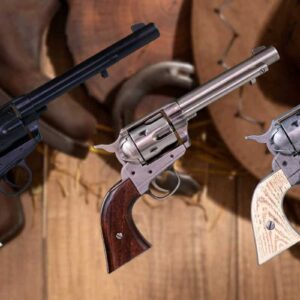
When picking up an exact replica like the Colt Peacemaker 45 USA 1873 Revolver, the balance provided by the metallic barrel contrasting with the warm wooden grip immediately transmits that historical authority. It is that inertia when tracing its contours and feeling its poise that transports you directly to the 19th century, confirming that the quality of a true collectible replica is not measured only by sight, but through touch.
Kolser's Commitment: Engineering and Historical Fidelity in Every Gram
At Kolser, we understand that weight is not an accident, but a design choice. Our commitment to the collector demands that each piece not only looks like the original but feels identical in the hand. That is why we carefully calibrate the proportion of our Zamak alloys and the density of the noble woods or resins that make up the grips.
The result is a balanced center of gravity that perfectly emulates the poise of historical weapons. This meticulous attention to physical detail is what makes a Kolser replica a truly immersive experience, ensuring that the heft premium is the non-negotiable standard in every single one of our models.



 EN
 ES
 FR
 DE
 IT