

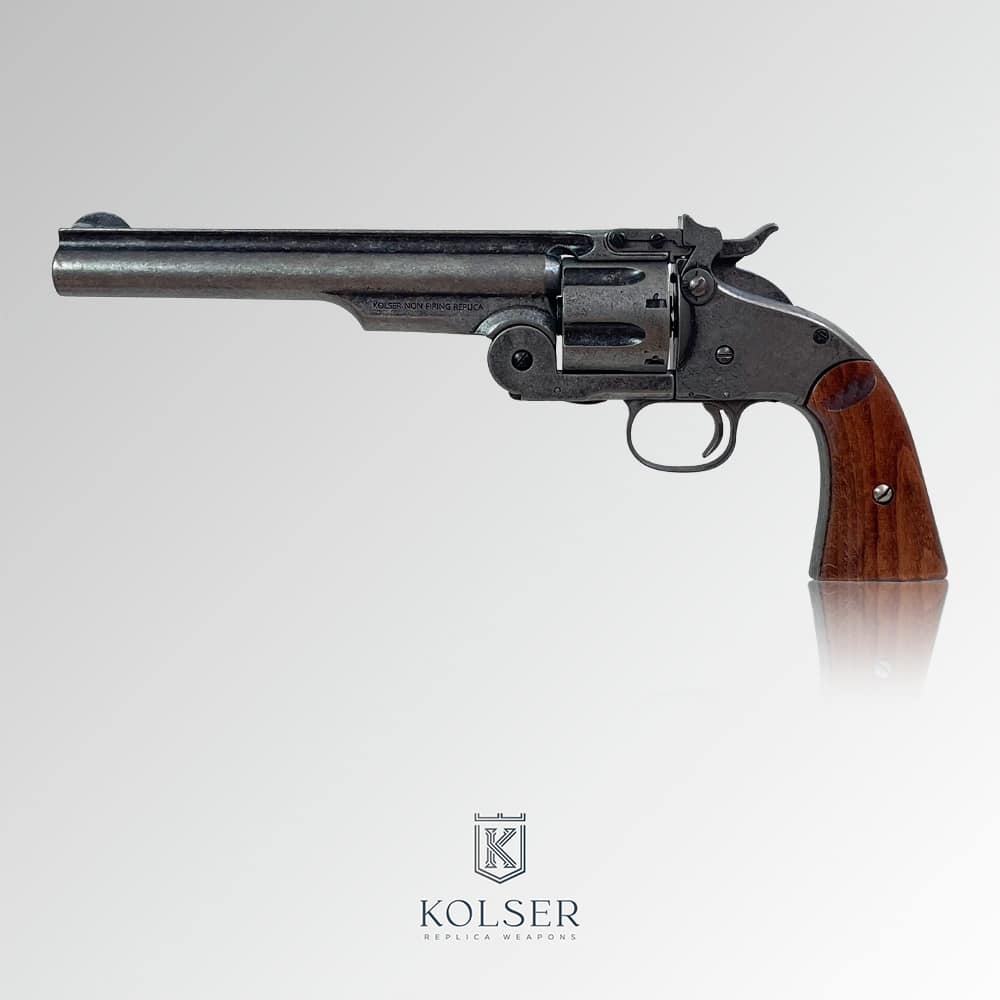
During the second half of the 19th century, the United States underwent a profound transformation. The westward expansion, the development of the railroad, and the military campaigns in the frontier territories coincided with a period of great advancement in weapons manufacturing.
The old percussion revolvers began to be replaced by models that used metallic cartridges, which were faster and more practical to load. In this context emerged the Schofield revolver, a variant of the Smith & Wesson Model 3 adapted to the needs of cavalry soldiers.
Its characteristic top-break system allowed the frame to be opened, all casings to be ejected simultaneously, and the six chambers to be accessed quickly. This ease of handling made it one of the most interesting designs of its time and one of the most recognizable historical weapons of the Old West.
The origin of the Schofield
Who was George W. Schofield?
George W. Schofield was a US Army officer with experience in cavalry units. His knowledge of the real conditions of military service allowed him to detect the difficulties a rider faced when handling and reloading a revolver while maintaining control of his horse.
In the early 1870s, Schofield began working on the Smith & Wesson Model 3, a metallic cartridge revolver that already incorporated a top-break opening system.
His intention was not to design a completely new weapon, but to improve the existing mechanism so that it could be handled more easily using a single hand. In this way, a soldier could open the revolver while holding the reins with the other.
The Smithsonian Museum preserves one of the models developed by Schofield in collaboration with Smith & Wesson, a piece that allows us to observe the origin of the improvements later applied to the military version.
From the Smith & Wesson Model 3 to the Schofield
Smith & Wesson introduced the Model 3 around 1870. It was a single-action, metallic cartridge, top-break revolver. If you also want to know the Model 1 and the Model 2 Army, the first designs with which the firm introduced the metallic cartridge, you can read our article on the history of the early Smith & Wesson revolvers.
As with the Colt Single Action Army and the Remington Model 1875, the user had to manually cock the hammer before each shot. The great difference lay in the structure of the frame and the way to access the cylinder.
In the Model 3, the barrel and cylinder could tip forward by releasing the latch located behind the cylinder. Schofield modified this latch to make it more accessible so it could be operated with the thumb of the hand holding the weapon.
The adaptation responded directly to the needs of the cavalry and gave rise to the variant that would end up being known by the officer's surname.
How did the Schofield work?
Top-break design
The operation of the Schofield could be summarized in a quick sequence.
First, the user actuated the latch located on the top of the frame. Then, the barrel and cylinder tipped forward around a lower hinge. During this opening, the extractor lifted the casings and left the six chambers accessible to insert new cartridges.
This system allowed the entire cylinder to be unloaded through a single opening, whereas in other revolvers of the time, the casings had to be removed individually.
The speed of the operation was especially useful for a mounted soldier, who needed to manipulate the weapon with the fewest possible movements without losing control of his horse.
In addition to being a practical advantage, the full opening of the frame gave the Schofield an unmistakable appearance. The movement of the barrel and cylinder remains one of the elements that best identify this model.
The .45 Schofield cartridge
The military variant used a cartridge initially known as the .45 Smith & Wesson and later popularized as the .45 Schofield.
This cartridge was shorter than the .45 Colt used by the Colt Single Action Army. The difference was due to the fact that the Smith & Wesson cylinder was not long enough to accommodate the long Colt cartridge.
The .45 Schofield could indeed be used in the Colt Single Action Army, but the compatibility did not work in reverse.
This situation generated supply difficulties. Soldiers equipped with Colt could use both munitions, while Schofield users necessarily needed to receive the short cartridge.
The .45 Schofield was also generally less powerful than the original .45 Colt loads. However, its main military drawback was the logistical difficulty of maintaining two revolvers in service with different ammunition requirements.
The Schofield in the Old West
Its use in the US Army
The US Army adopted the Schofield during the 1870s and assigned it mainly to cavalry units deployed in the West.
Its fast unloading and the ability to access all six chambers through a single opening were significant advantages for mounted troops. However, the Colt Single Action Army remained the most widespread revolver within the armed forces.
The Colt had a simpler mechanism, a closed frame, and greater ammunition compatibility. These features, along with its extensive production and distribution, helped it to become the predominant standard-issue model.
In a military evaluation conducted in 1876, the Army compared the Schofield, the Colt Single Action Army, and the Remington Model 1875. Although the speed of the Smith & Wesson was appreciated, the commission felt that the Colt offered a more suitable package for general service.
How did it differ from its main rivals?
The Schofield, the Colt Single Action Army, and the Remington Model 1875 were single-action revolvers with a six-cartridge capacity. However, they used very different construction and reloading systems.
The Schofield had a hinged frame. When opened, the cylinder was fully accessible, and the casings were extracted simultaneously.
The Colt and the Remington used a closed frame and a fixed cylinder. To load or unload them, it was necessary to rotate the cylinder and work with each chamber individually.
The Schofield offered a faster full reload. Colt and Remington, on the other hand, opted for simpler and more robust mechanisms.
The Colt also had an important logistical advantage: it could use both the .45 Colt and the short .45 Schofield cartridge. This compatibility contributed to its greater military diffusion.
Comparison: Schofield vs. Colt SAA vs. Remington 1875
| Characteristic | Schofield | Colt Single Action Army | Remington Model 1875 |
|---|---|---|---|
| Action type | Single action | Single action | Single action |
| Capacity | Six cartridges | Six cartridges | Six cartridges |
| Frame type | Hinged or top-break | Closed and fixed | Closed and fixed |
| Case extraction | Simultaneous | Individual | Individual |
| Main advantage | Fast unloading and reloading | Simplicity and wide diffusion | Robust construction |
| Main limitation | Did not accept the .45 Colt | Slow reloading | Slow reloading and less diffusion |
It cannot be stated that one of the three models was superior in all aspects. The Schofield stood out for its speed; the Colt, for its simplicity and diffusion; and the Remington, for its traditional and robust construction.
From military service to the civilian market
After their service period, numerous Schofields were sold as military surplus and passed to the civilian market.
Some specimens were reconditioned, received new finishes, or had their barrel lengths reduced. These modifications allowed a large military revolver to be converted into a more manageable weapon for transporters, security agents, and other civilian users.
The Wells Fargo Schofields
Wells Fargo is one of the companies most closely related to these revolvers.
Specimens from the Army that were later used by the company have been preserved, featuring shortened barrels and different identification marks applied to the frame.
These weapons became particularly well-known pieces within Old West collecting. However, their authenticity must be analyzed individually, as the marks attributed to Wells Fargo have also been reproduced on subsequently modified specimens.
For this reason, collectors highly value pieces whose provenance can be proven through serial numbers, records, and historical documentation.
Jesse James and the Schofield
The Schofield is often associated with some of the most famous characters of the Old West, including Jesse James and the James-Younger gang.
Over the years, several specimens attributed to the famous outlaw and some of his companions have surfaced. In 2021, the Bonhams auction house presented one cataloged as attributed to Jesse James.
These identifications should be interpreted with caution. In many cases, they are based on family stories, later documents, or chains of ownership that are difficult to verify.
Therefore, it cannot be stated with certainty what Jesse James' personal weapon was. However, the traditional relationship between the outlaw, his gang, and the Schofield is part of the history and legend of the Old West.
The Schofield in popular culture
Although it never reached the diffusion of the Colt Single Action Army, the Schofield became one of the most recognizable western revolvers.
Its silhouette, its large frame, and its top-break opening immediately distinguish it from the Colt and Remington models. These characteristics have favored its appearance in movies, video games, and other works set in the American West.
The Schofield in Unforgiven (1992)
One of its most memorable cinematic appearances is in Unforgiven, a 1992 film directed by and starring Clint Eastwood.
One of its characters is a young aspiring gunfighter known as The Schofield Kid. His nickname comes precisely from the Smith & Wesson Schofield he carries with him.
Later, the young man gives the weapon to William Munny, played by Clint Eastwood, who uses it during the film's climax.
The Schofield does not function merely as a prop. Its transition from one character to another accompanies the evolution of the story and links it to one of the most recognized westerns of modern cinema.
The Schofield in Red Dead Redemption 2
The popularity of the model has been renewed thanks to Red Dead Redemption 2, where it appears as one of the revolvers the player can use and customize.
Rockstar Games reproduces its most characteristic visual elements, such as the large frame and the top-break opening system, differentiating it from other revolvers inspired by Colt or Remington models.
Its performance is adapted to the needs of the video game and should not be interpreted as an exact reproduction of its historical behavior. However, its presence in the title has brought the name Schofield closer to a new generation of western fans.
The Schofield as a collector's piece
Original specimens are currently highly prized by collectors of American historical weaponry.
Their value depends on factors such as the state of preservation, the originality of the components, military markings, barrel length, and documentation that allows the reconstruction of their provenance.
Models preserved without modifications hold special historical interest. Units transformed for the civilian market are also appreciated, especially when their relationship with transport companies or other episodes of the American West can be proven.
Weapons attributed to characters like Jesse James can achieve great notoriety, but they require a particularly careful analysis of their documentation and chain of ownership.
Alongside original pieces, modern reproductions and decorative replicas allow enthusiasts to explore the shapes and characteristics of this model without the need to acquire a historical weapon.
The legacy of the Schofield
The Schofield was born as a practical adaptation of the Smith & Wesson Model 3 to respond to the needs of the US cavalry.
Although its production and diffusion were smaller than those of the Colt Single Action Army, its particular opening system allowed it to occupy a unique place in weaponry history.
It also became a recognizable symbol of the Old West thanks to its time in the Army, its subsequent presence in the civilian market, and its association with characters, movies, and video games that have kept its name alive.
More than a century after its appearance, it continues to awaken the interest of historians, collectors, and western fans. The Schofield represents a mechanical solution distinct from that of its great rivals and one of the most characteristic designs of its era.
Discover the Kolser Schofield revolver
The characteristic top-break system made the Schofield one of the most recognizable designs of the Old West and continues to be one of its main attractions for collectors and enthusiasts.
The Kolser reproduction incorporates a simulated mechanism that allows you to cock the hammer and pull the trigger, rotate the cylinder, tip the revolver's barrel, and simultaneously eject the six decorative cartridges.
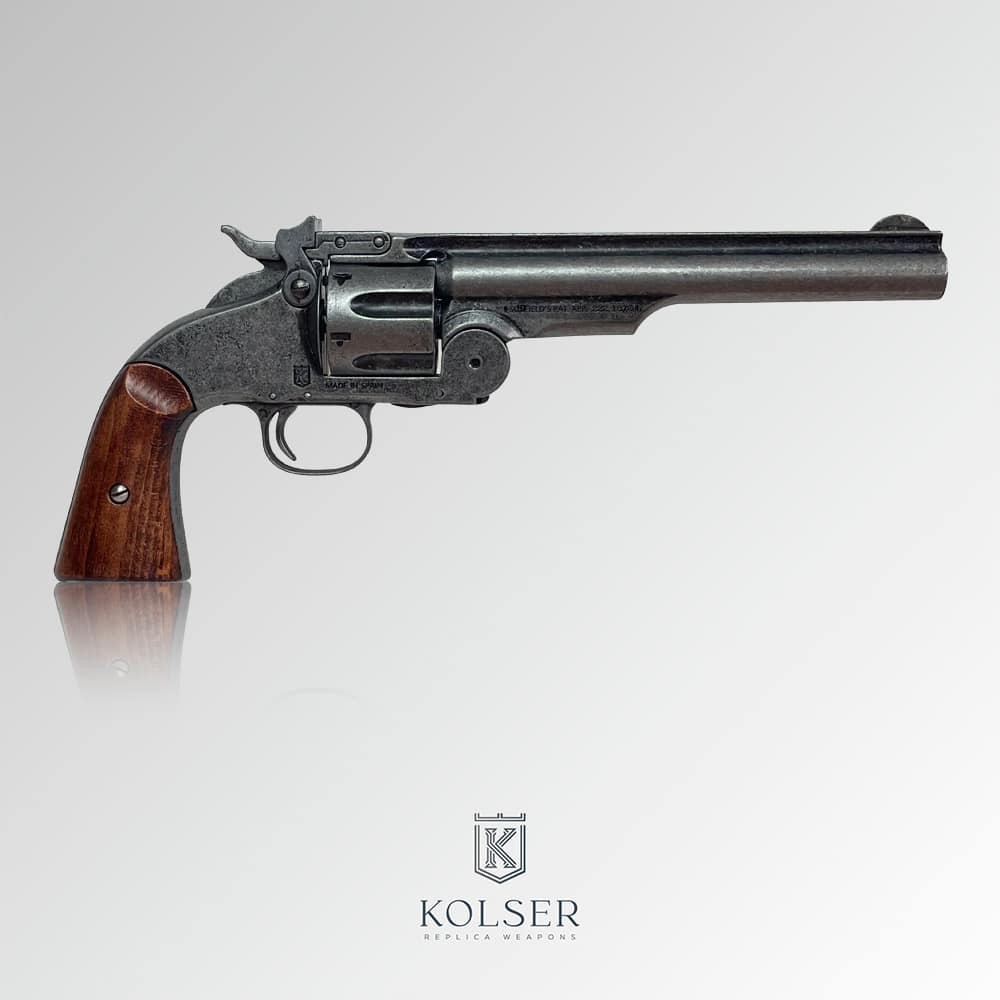


With careful attention to finishes and the elements that identify this historic model, our decorative replica is perfect for collections, historical recreations, exhibitions, and audiovisual productions. It is a way to get closer to the mechanism that distinguished it from other great western revolvers.


 EN
 ES
 FR
 DE
 IT