

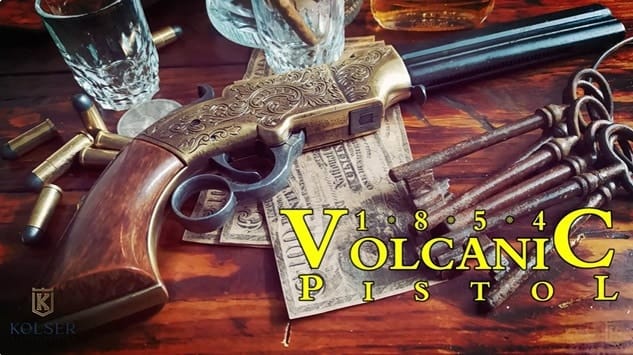
Long before Winchester rifles became an enduring symbol of the American Old West, the Volcanic 1854 pistol already featured a lever-action repeating mechanism and a tubular magazine, two key innovations that would later play an important role in the development of the Henry and Winchester rifles.
Although it never achieved the commercial success of contemporary revolvers, the Volcanic holds an important place in American firearms history thanks to its contribution to the development of repeating firearms.
From Walter Hunt to Smith & Wesson: The Origins of the Volcanic
The story begins in 1848, when American inventor Walter Hunt developed the Volition Repeater, a lever-action repeating rifle fitted with a tubular magazine and designed to fire an unusual type of ammunition known as the Rocket Ball. Despite its innovative design, the rifle suffered from mechanical problems and never achieved commercial success. Lewis Jennings subsequently improved the mechanism, leading to the development of a new repeating rifle.
The rights to these inventions changed hands several times, passing through businessman Courtlandt C. Palmer before eventually reaching Horace Smith and Daniel B. Wesson, who continued to refine the mechanism.
In 1854, Smith and Wesson patented a repeating mechanism that led to the first pistols later known as Volcanic. The following year, in 1855, the Volcanic Repeating Arms Company was established to manufacture pistols and carbines based on this design.
How Did the Volcanic Pistol Work?
Unlike revolvers, which used a rotating cylinder, the Volcanic stored its ammunition in a tubular magazine beneath the barrel. A lever beneath the pistol operated the repeating mechanism. Operating the lever chambered a new round and cocked the hammer, allowing the shooter to fire several rounds in succession without manually reloading after each one.
This was a particularly interesting feature for a pistol at the time, although its effectiveness was limited by the ammunition it used.
Rocket Ball Ammunition: The Volcanic's Greatest Weakness
Volcanic pistols used ammunition derived from the Rocket Ball, originally developed by Walter Hunt. Unlike conventional metallic cartridges, each bullet had a hollow base containing a small powder charge and a priming compound. The limited space available for propellant severely restricted the power of the ammunition.
Furthermore, because the ammunition had no separate metallic cartridge case, the mechanism lacked a conventional extraction and ejection system. This was generally not an issue when the pistol operated correctly, but it could make removing defective ammunition or a jammed projectile difficult.
These shortcomings, particularly the ammunition's limited power, hampered the Volcanic's commercial success at a time when percussion revolvers were far more widely used across the United States.
From the Volcanic Pistol to the Henry and Winchester Rifles
The Volcanic Repeating Arms Company ran into financial difficulties, and in 1857, one of its investors, businessman Oliver Fisher Winchester, acquired its assets and reorganised the business as the New Haven Arms Company.
During this period, Benjamin Tyler Henry played a crucial role in improving the repeating mechanism and adapting it to fire a .44 calibre rimfire metallic cartridge. This development addressed one of the Volcanic's main weaknesses: its underpowered ammunition. The result was the Henry rifle, patented in 1860 and commercially available from 1862. Its action retained principles from earlier designs while using more powerful and reliable ammunition.
In 1866, the Winchester Model 1866 appeared. Nicknamed the Yellow Boy because of its brass receiver, it was the first rifle sold under the Winchester name and helped establish lever-action repeating rifles as an iconic feature of the American West.
Was the Volcanic Pistol Commonly Used in the Old West?
Although developed during the period of westward expansion, the Volcanic pistol was produced in relatively small numbers and never achieved the popularity of Colt or Remington revolvers. There is insufficient historical evidence to suggest that it was commonly carried by cowboys, lawmen or outlaws. Nor was it a widely issued military firearm during the American Civil War (1861–1865). By the time the conflict began, production of Volcanic pistols had already ended, and repeating firearms technology was moving towards more effective designs.
The Volcanic's historical importance therefore lies not in its involvement in the best-known events of the Old West, but in its contribution to the evolution of American repeating firearms.
Kolser's Volcanic 1854 Pistol Replica
The Volcanic is a particularly fascinating firearm thanks to its distinctive mechanism and its role in the development of lever-action repeating rifles.
Our replica is made from zinc alloy (Zamak) and features moving mechanisms that recreate characteristic elements of the original design. It is a non-firing decorative replica, unsuitable for firing live ammunition, designed for collectors and display purposes.
For firearms history enthusiasts, the Volcanic offers a glimpse into an important period before the development of the Henry rifle and the earliest Winchesters. As part of a historical firearms collection, it helps illustrate how lever-action repeating mechanisms evolved throughout the 19th century.


 EN
 ES
 FR
 DE
 IT