


Coats of arms are graphic representations that emerged in medieval Europe, especially between the 12th and 13th centuries, as visual signs intended to identify their bearers in military and ceremonial contexts. Over time, heraldry evolved to also become a symbol of family identity, lineage, authority, and belonging.
Today, coats of arms have transcended their original function to become pieces of great historical and decorative interest. In the field of collecting and interior decoration, heraldry brings character, personality, and a visual connection to different periods in history.
What are coats of arms and what were they used for?
A coat of arms is described using a technical language known as blazon. Heraldry arose in medieval Europe in a context where warriors wore helmets and armor that made identification difficult. Medieval coats of arms served an important visual function, as the colors, figures, and compositions depicted on them allowed for the distinction of certain individuals, families, or groups, especially in tournaments and military contexts.
Early heraldic compositions could include colors, geometric partitions, bands, crosses, and various figures. Over time, these symbols acquired a more stable character and became associated with families, lineages, territories, cities, and institutions.
As military tactics changed and firearms gained increasing importance, the use of full armor gradually declined on the battlefield. However, heraldry did not disappear. On the contrary, it continued to be used in family, political, institutional, military, and ceremonial contexts.
Coats of arms began to appear on official documents, buildings, seals, tapestries, monuments, ceremonial weapons, and other objects linked to the representation of power and identity.
Elements of heraldry: how to interpret a blazon
Heraldry has its own language and specific conventions. For a collector to better understand the meaning and context of a heraldic piece, it is useful to know some of its fundamental elements.
Forms and partitions of the field
The background of the shield is called the field. Its shape can vary according to the era, territory, and heraldic tradition. In the Spanish tradition, quadrilong shields, generally rounded at the bottom, are common, although there are numerous historical and artistic variations.
The field can be divided by geometric lines and partitions. Among these compositions are quartered shields, which can be used to combine different arms and represent alliances, inheritances, dynastic rights, territories, or the union of distinct family traditions.
The meaning of colors and figures
In heraldry, the colors and metals that make up a shield are called tinctures (enamels). Among the most well-known are gold, silver, gules (red), azure (blue), vert (green), and sable (black).
According to traditional symbolic interpretations, gold is associated with values such as nobility, generosity, and wealth, while gules can be related to courage, strength, and the warrior spirit. These interpretations should be understood as traditional symbolic conventions, as their historical application was not always uniform.
Upon the field, heraldic figures, known as charges, are placed. Among them, we find animals like the lion or the eagle, architectural elements such as castles and towers, weapons, crosses, stars, and numerous symbolic figures.
The combination of tinctures and figures allows for the creation of visually recognizable compositions laden with historical and cultural meaning.
From knights to institutions: the evolution of heraldry
As military tactics and European societies evolved, so did heraldry. Its use ceased to be solely linked to the identification of warriors and families and extended to cities, territories, institutions, universities, corporations, orders, and military units.
During the Modern Age and the 18th and 19th centuries, coats of arms and other emblems of authority frequently appeared on buildings, official documents, uniforms, flags, ceremonial objects, and weapons of representation.
Heraldic symbols were also present on officer sabers, dress swords, and other weapons linked to military and state authority. In many cases, these objects combined a ceremonial function with an important symbolic dimension.
This evolution explains why, today, heraldry remains closely related to historical collecting and themed decoration.
If you are thinking of taking the next step in your hobby, we recommend discovering the top most sought-after weapon replicas to get inspired and find the pieces that best accompany your heraldry.
Comparative guide: heraldry and historical weaponry
In this table, we show you how to relate heraldic aesthetics with the appropriate weaponry:
| Historical Era | Predominant Heraldic Style | Associated Weaponry for Display | Recommended Kolser Replica |
|---|---|---|---|
| High Middle Ages | Intense tinctures, geometric partitions, and chivalric tradition shields. | Knight swords, axes, and crossbows. | Excalibur Sword |
| Renaissance | Quartered shields, canting arms, and dynastic alliances. | Rapiers and daggers. | Toledan Dagger |
| Napoleonic Period | Imperial eagles, crowns, and emblems associated with state power. | Sabers and dress swords. | Napoleon Sword |
These correspondences are mainly indicative and decorative. A modern replica can be inspired by a historical period, character, or tradition without necessarily constituting an exact archaeological reproduction of a specific weapon.
The coat of arms in current decoration
Today, coats of arms have become highly attractive decorative pieces for offices, libraries, living rooms, and spaces dedicated to collecting.
Their aesthetics allow for the creation of environments with medieval, Renaissance, imperial, or military inspiration, depending on the style of the piece and the other elements that accompany it.
At Kolser, we know that many collectors look for a common thread in their collections, whether through a Viking, medieval, Napoleonic theme, or related to other historical periods.
Wall panoplies and historical replicas to display in your home
Displaying a decorative replica takes on a completely different meaning when framed appropriately. Wall panoplies that integrate blazons are the preferred option to transform any corner into an authentic museum room, allowing swords or sabers to be crossed under a representative emblem.

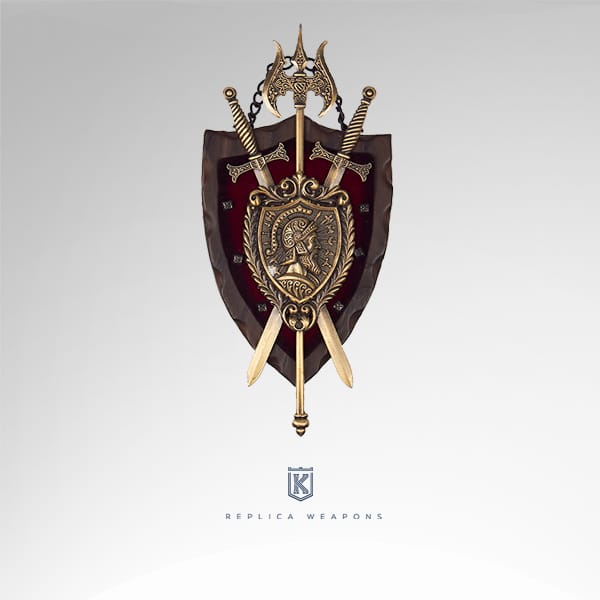

At Kolser, attention to detail is a fundamental part of our decorative pieces. Our panoplies and shields combine different materials and finishes to create compositions inspired by the aesthetics of historical armories and heraldic tradition.
The reliefs, ornamentations, and decorative finishes contribute to recreating the appearance of pieces linked to different eras and styles, from the medieval tradition to imperial and military aesthetics.
The result is pieces designed for those who wish to incorporate history, heraldry, and collecting into their home decor.


 EN
EN  ES
ES  FR
FR  DE
DE  IT
IT