

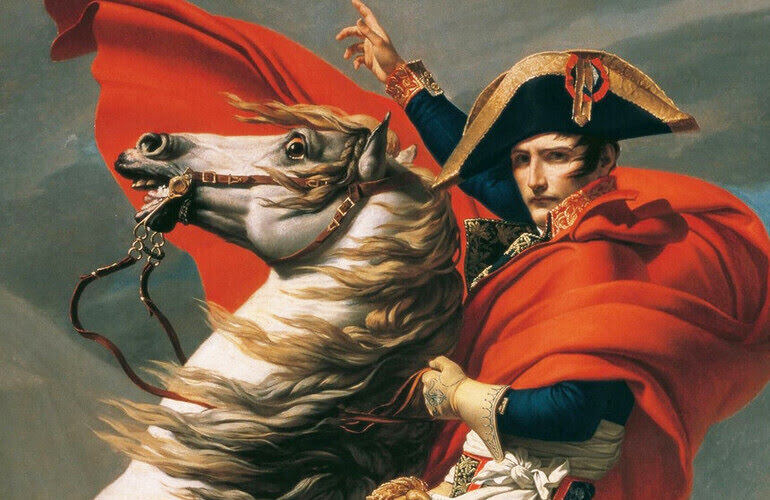
Napoleon Bonaparte is one of those figures seemingly carved from ambition and gunpowder. Hero and villain, strategist and dictator, revolutionary and emperor: his image transcends any simple definition. Under his command, Europe lived through one of its most intense periods: a whirlwind of wars and transformations that still echo in our history today.
Who was Napoleon Bonaparte and what did he do in the French Revolution
Napoleon emerged amidst the chaos of the French Revolution, a time when the old order was crumbling and the army became a platform for the boldest to rise. It was precisely in this context of instability that the young Corsican forged his destiny and began building a reputation as a military genius.
Origins and early education
Born in 1769 in Ajaccio, on the island of Corsica, Napoleon grew up in a family of the minor local nobility. His character was forged amid the tensions of an island recently conquered by France and the strong Italian cultural roots of his heritage. From a young age, he displayed iron discipline, a prodigious memory, and an obsession with military history, admiring figures like Alexander the Great and Julius Caesar.
Military education in France
At just nine years old, he traveled to mainland France to enroll in the military school of Brienne. There, he excelled in mathematics and showed great talent for artillery—a branch that would later become the backbone of his victories. His time at the École Militaire in Paris confirmed his promise as a young officer, though he also carried the stigma of being a foreigner, forcing him to prevail through effort and determination.
First successful campaigns: Toulon and the Italian campaign
His rise began in Toulon (1793), where, in charge of artillery, he devised a strategy that forced the British fleet to withdraw. From that moment, his reputation only grew. The Italian campaign (1796–1797) showcased him as a bold leader, able to defeat numerically superior armies through rapid troop movements and precise artillery coordination. It was in those battles that the legend of Napoleon as a master of war began to take shape.
Consolidation of power in France
After his early victories, Napoleon understood that military glory had to be accompanied by political control. France was mired in the Directory’s instability, and he was ready to seize the opportunity.
The coup of 18 Brumaire
On November 9, 1799 (18 Brumaire in the revolutionary calendar), Napoleon took a decisive step: with military and political support, he dissolved the Directory and established the Consulate. This marked the end of the Revolution and the beginning of an authoritarian regime that nevertheless restored stability to France.
From First Consul to Emperor of the French
As First Consul, he concentrated more and more power in his own hands. Barely five years later, in 1804, he proclaimed himself Emperor of the French in a lavish ceremony at Notre Dame. The most remembered gesture was when he took the crown from the Pope’s hands and placed it on his own head: a powerful symbol that he recognized no authority above his own.
What Napoleon Bonaparte did: invasion of Spain and the Spanish War of Independence
Napoleon’s ambition and his sword knew no borders, and the Iberian Peninsula became one of his most complex arenas.
The sinking of the frigate Mercedes and the declaration of war on Great Britain
The Franco-Spanish alliance against Great Britain included dramatic episodes such as the sinking of the frigate Nuestra Señora de las Mercedes in 1804. The British attack on this ship, loaded with American silver, was not only a severe economic blow but also a spark that intensified hostilities, paving the way for the Peninsular War.
Occupation of Spain and the Continental Blockade
In 1808, after the abdications at Bayonne, Napoleon placed his brother Joseph Bonaparte on the Spanish throne, triggering an unprecedented popular uprising. At the same time, he reinforced the Continental Blockade, designed to strangle Britain’s economy by banning its trade in Europe. Spain thus became a decisive battleground where both military and economic wars were fought.
Consequences of the War of Independence for the French Empire
Far from being a quick victory, the War of Independence became a bottomless pit for the Empire. Guerrilla warfare, popular resistance, and British intervention turned the peninsula into a relentless drain on French resources and morale. This conflict weakened Napoleon’s war machine and opened a rift he never managed to close.

Decline and fall of Napoleon Bonaparte
Like every empire forged in the heat of war, Napoleon’s also had a breaking point.
The defeat in the invasion of Russia and its consequences
In 1812, he launched the disastrous invasion of Russia, confident in repeating past glories. With an army of over half a million men—the Grande Armée—he ventured into a vast territory where cold, hunger, and Russian scorched-earth tactics destroyed him. Only a handful returned. It was the beginning of the end.
The Battle of Leipzig and the abdication
A year later, in 1813, the united European powers defeated Napoleon at Leipzig, in the so-called “Battle of the Nations.” With no resources or allies, he abdicated in 1814 and accepted exile on the island of Elba—a small throne for a fallen emperor.
Exile to the island of Elba and return during the Hundred Days
His stay on Elba was brief. In 1815 he escaped and landed in France, where he was received as a hero. He regained power during a period known as the Hundred Days—a final attempt to restore his empire against his enemies.
The Battle of Waterloo and final exile to Saint Helena
The dream ended at Waterloo, where he was definitively defeated by the Duke of Wellington and the Prussian troops. This time, there was no indulgence: he was sent to the remote island of Saint Helena, in the middle of the Atlantic, where he died in 1821, guarded and isolated from the world he once ruled.
Legacy of Napoleon Bonaparte
Beyond his military campaigns, Napoleon left a legacy that still pulses through contemporary history.
Influence on law and public administration
The Napoleonic Civil Code (1804) was one of his greatest contributions: a legal framework establishing principles such as equality before the law and protection of property. He also modernized administration, reorganized education, and founded the Bank of France, laying the foundations of a centralized and efficient state.
Spread of the ideals of the French Revolution
Although he built a highly centralized empire, Napoleon also carried with him the ideals of the Revolution. Wherever his armies marched, feudal privileges were abolished and principles of equality took root, gradually reshaping Europe’s political landscape.
Impact on European and global geopolitics
His downfall paved the way for the Congress of Vienna (1815), which sought to balance European powers and prevent future imperial ambitions. On a global scale, his wars weakened Spain and Portugal, clearing the path for independence movements in the Americas that would redraw the world map.
Conflicting evaluations: military genius vs. authoritarianism
Napoleon remains a controversial figure: for some, a strategic genius who modernized Europe; for others, a tyrant who sacrificed millions of lives in the name of his ambition. That duality is perhaps what makes him one of the most fascinating figures in history.
Napoleon Bonaparte was much more than a brilliant military man: he was an architect of modern Europe, a man who mastered both the sword and the law. His shadow still looms over politics, culture, and collective memory. And as with all great historical figures, his legacy remains alive in every debate, in every historical reenactment, and in every replica of the weapons he once carried, reminding us that history is not just told—it is relived.


 EN
EN  ES
ES  FR
FR  DE
DE  IT
IT