

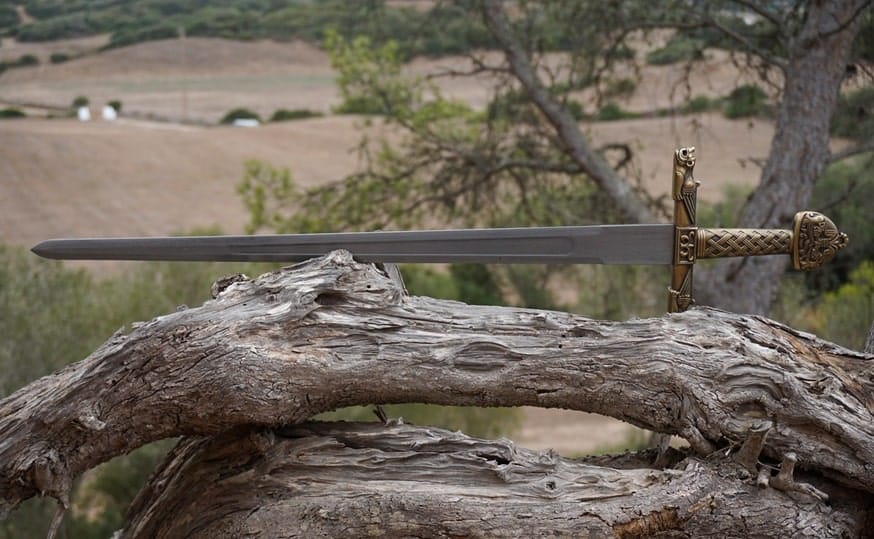
Medieval swords are one of the great symbols of power, honor, and the warrior tradition of the Middle Ages. If you are looking for medieval sword replicas for collecting, interior decoration, theater, or historical reenactment, at Kolser you will find decorative pieces inspired by historical and legendary models. All our sword replicas are made of Zamak, a metal alloy that offers resistant, detailed finishes designed to convey a sense of authenticity.
From the swords associated with the Crusades to the legendary arms attributed to El Cid, these pieces allow you to tangibly approach one of the most representative objects of the medieval world.
The Meaning of the Sword in the Middle Ages
To understand the true meaning of the sword during the Middle Ages, one must look beyond its function as a weapon.
In European medieval society, the sword was closely linked to the nobility, chivalry, and the exercise of arms. The highest quality pieces could represent status, authority, prestige, and belonging to a certain lineage, although their use was not exclusively limited to nobles and knights.
The sword also acquired an important ceremonial and symbolic dimension. Its shape, with a straight blade and a transverse crossguard, further favored its visual association with the cross in Christian Europe.
Therefore, swords appear linked to investiture ceremonies, oaths of loyalty, coronations, and representations of power.
Some even reached a legendary dimension. Excalibur, linked to the Arthurian cycle, became one of the great symbols of European medieval literature. Similarly, Joyeuse, traditionally associated with Charlemagne and later used as the ceremonial sword of the French monarchy, demonstrates the extent to which these weapons could transcend the battlefield to also become emblems of legitimacy and power.
Morphology and Historical Accuracy: The Anatomy of a Medieval Sword
A medieval sword was the result of a careful balance between dimensions, resistance, and functionality.
Although their shapes varied considerably over the centuries, many shared several fundamental elements.
The Blade
This was the main part of the sword and could present different shapes depending on the era and the intended use.
Some medieval blades were relatively wide and primarily designed for cutting, while other later designs tended to incorporate stiffer profiles and more pronounced points that facilitated thrusting.
Many 11th and 12th-century swords also incorporated a longitudinal groove or fuller, which allowed reducing mass without needing to make the blade excessively thin.
The Crossguard
Located between the blade and the grip, it primarily helped protect the user's hand against the opponent's blade.
Crossguards could adopt very different shapes depending on the era, ranging from straight and simple designs to more elaborate variants.
The Grip
It was the area intended for gripping, and its length varied depending on the type of sword. One-handed swords used relatively short grips, while longswords incorporated longer grips that allowed both hands to be used.
The Pommel
Located at the end of the grip, the pommel contributed to securing the assembly and balancing the weight of the blade, facilitating the handling of the sword.
In addition to its practical function, it could incorporate decorative or identifying designs.
Medieval Replicas: Realism Beyond Appearance
For a collector or a historical characterization, visual appearance is important, but so are the proportions, the weight, and the feeling the piece conveys.
Our sword replicas are made of Zamak, a metal alloy that allows the aesthetics of historical weapons to be reproduced in detail, without incorporating fine woods or leather. Depending on the model, they may feature ornamental hilts, worked crossguards, engravings, and other details inspired by historical or legendary pieces.
These replicas are conceived primarily for decoration, collecting, theatrical props, and reenactment, and not as weapons intended for combat.
Evolution and History of Medieval Swords
Medieval swords evolved over centuries.
Their design was never completely static: it changed as combat techniques, defensive systems, armor, and manufacturing methods evolved.
Therefore, speaking of a single "medieval sword" is overly simplistic. Between the 11th and 15th centuries, we find numerous typologies adapted to different military contexts.
Norman Swords, the Reconquista, and the Crusades
During the 11th and 12th centuries, one-handed swords were common.
Many featured relatively wide blades and a longitudinal groove intended to reduce part of their mass while maintaining a sturdy structure.
This type of sword could be used both on foot and on horseback and was usually combined with different types of shields.
Its silhouette is one of the most widely identified today with the knights of the Crusades and the classic image of the medieval warrior.
In our catalog, you can find pieces inspired by this era, such as the Barbarossa Sword, associated with Frederick I Barbarossa, Holy Roman Emperor and one of the great protagonists of the Third Crusade.
For lovers of peninsular history, replicas of the Colada Sword and Tizona Sword also stand out, the legendary weapons traditionally attributed to Rodrigo Díaz de Vivar, El Cid Campeador.
Their presence in medieval literary tradition turned both swords into symbols closely associated with the figure of El Cid and his legend.
The Longsword in the Late Middle Ages
As the Middle Ages progressed, bodily protection evolved as well.
During the 14th and 15th centuries, armor progressively incorporated more complete and sophisticated plate systems, also modifying some of the needs of combat.
In this context, longswords gained prominence, characterized by extended grips that allowed the use of one or both hands depending on the model and the situation.
These swords provided greater control of the weapon and allowed the development of specific combat techniques.
Some designs also incorporated stiffer blades and more pronounced points, suitable for directing thrusts towards vulnerable areas or the gaps existing between armor pieces.
It was not simply about piercing a metal plate, but about adapting combat techniques to increasingly sophisticated defensive systems.
11th-12th Century Sword vs. Late Medieval Longsword
The evolution of the sword can be better understood by comparing some of the most common characteristics of different periods:
| Characteristic | 11th-12th Century Sword | Late Medieval Longsword |
|---|---|---|
| Typical Use | Primarily one-handed | One or two hands, depending on model and context |
| Grip | Relatively short | More extended |
| Blade Type | Frequently wide and with a fuller | Tendency towards longer and stiffer blades |
| Point | Variable depending on the model | In many designs, more pronounced |
| Historical Context | Cavalry, infantry, Crusades, and feudal wars | Late medieval combat and more developed armor |
| Examples at Kolser | Barbarossa, Tizona, and Colada | Swords inspired by medieval kings and knights |
This evolution was neither linear nor identical throughout Europe. For centuries, different types of swords coexisted, adapted to the needs of each combatant and the military traditions of each region.
Tizona and Colada: The Legendary Swords of El Cid
Among the best-known swords of the Spanish medieval tradition are Tizona and Colada.
Both appear linked literally to Rodrigo Díaz de Vivar and form a fundamental part of the legendary image of El Cid Campeador.
Medieval literature contributed enormously to transforming these weapons into symbols of victory, prestige, and honor.
For this reason, they remain some of the most recognizable historical swords for collectors and enthusiasts of the history of the Iberian Peninsula.
Replicas allow these designs to be incorporated into private collections, decorative spaces, or characterizations inspired by the 11th century and the literary universe of El Cid.
Excalibur: The Most Famous Sword of Arthurian Legend
Few swords have achieved fame comparable to Excalibur.
Linked to the figure of King Arthur, it represents much more than a weapon: within the different Arthurian traditions, it becomes a symbol of royalty, legitimacy, and destiny.
Although it belongs to the realm of legend and literature, its influence on the medieval imagination has been extraordinary.
Today it remains one of the most recognizable pieces among fans of medieval fantasy, Arthurian literature, and collecting.
Excalibur is just one of many examples of how certain weapons have ended up acquiring an identity of their own. If you are interested in knowing other cases, you can discover more legendary swords of history and the stories that have contributed to turning them into authentic cultural icons.
How to Care for a Zamak Sword Replica
To properly preserve a decorative replica, it is important to consider the materials with which it is manufactured. In the case of swords, all our replicas are made of Zamak.
Zamak is an alloy composed mainly of zinc and other elements like aluminum, magnesium, and copper. It is widely used in decorative pieces because it allows for detailed shapes and durable finishes.
For the regular maintenance of a replica, we recommend using a soft, dry cloth to remove dust and fingerprints accumulated on the surface.
It is advisable to avoid abrasive products, strong solvents, or tools that could scratch the surface finishes.
Since they're made entirely of Zamak, these cleaning and care recommendations apply to the whole piece.
Careful handling will help maintain the piece's appearance for many years.
Medieval Swords for Decoration and Collecting
A sword replica can become a centerpiece within a collection.
It can be used to decorate an office, a library, a themed room, or any space inspired by medieval history.
It is also particularly attractive as an accessory for:
- Historical collections
- Medieval decoration
- Theatrical productions
- Photoshoots
- Exhibitions
- cosplay and characterization;
- Historical reenactments and settings
The size and visual presence of a sword mean that it can easily transform a space and become one of its main focal points.
Historical Reenactment and Medieval Theatrical Props
Historical reenactment seeks to approach an era through clothing, objects, and setting.
In this context, a decorative replica can add an extra level of detail to a character.
A correctly proportioned sword, accompanied by a scabbard, a belt, or a wardrobe consistent with the era, helps to convey a much more convincing image.
However, each event may establish its own rules regarding access with metal objects or weapon replicas.
Before attending a fair, show, convention, or historical reenactment, it is advisable to consult the organization's conditions in advance.
Collecting and Decoration: Relive History with Kolser
A medieval sword is not merely a decorative object.
It also represents centuries of technological evolution, military culture, symbolism, and tradition.
From the swords associated with the Crusades to the legendary weapons of El Cid or the tales of King Arthur, each model allows you to approach a different era and history.
At Kolser, we have over five decades of experience in the manufacture of historical replicas and decorative pieces, seeking to reproduce in detail some of the most recognizable objects of the past.
Explore our collection of medieval sword replicas and find the piece that best fits your collection, your decoration, or the historical character you want to recreate.




 EN
 ES
 FR
 DE
 IT