

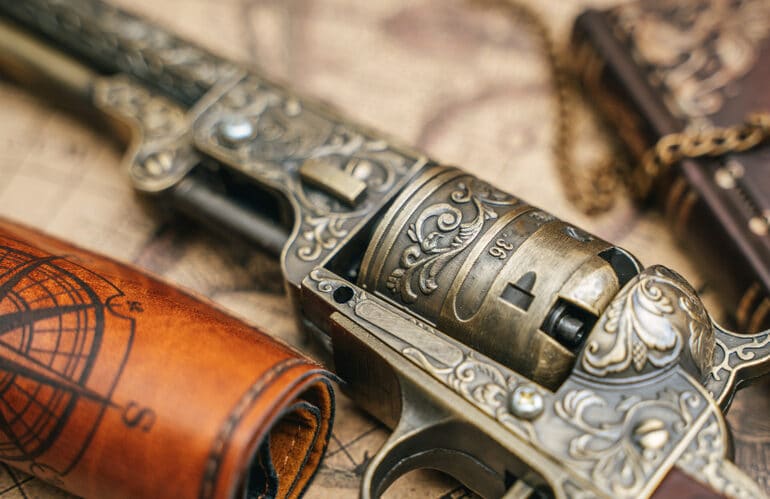
Choosing a weapon replica isn’t just about aesthetics: it’s history made tangible, a conversation starter in your display case, and an investment that could appreciate in value over time—whether you want it for decoration or historical reenactment. To make the right choice, it’s important to understand the different types of replicas available, how the “realism” of a piece is measured, and which practical factors (budget, technology, regulations, and maintenance) influence the final decision.
Available replica categories
The world of replicas is broad and fascinating. Knowing the options will help you build a coherent collection and, most importantly, enjoy every piece you add.
Swords and katanas
European swords and Japanese katanas are magnets for collectors, both for their symbolism and the craftsmanship behind them. Consider whether you're looking for a purely decorative piece or models with carbon steel blades that offer much greater realism in texture, grain, and shine. For katanas, check the fit of the saya (scabbard), the quality of the tsuka-ito (handle wrap), and the detail of the habaki and tsuba. For swords, inspect the guard, pommel, central groove, and historical proportions. A good replica feels balanced when held and has a subtle, non-exaggerated patina.
Axes and daggers
Ideal for Viking, medieval, or Renaissance collections, axes and daggers allow you to appreciate rivets, engravings, and handcrafted details. In decorative axes, the key lies in the metal’s color, the edge’s texture (which shouldn’t be sharp), and the grain of the handle. For daggers, pay special attention to symmetry, the guard, and the sheath: a solid piece, without looseness or rattles, instantly enhances the sense of authenticity.
Muskets and rifles
Flintlock, matchlock, or percussion muskets are pure history. Faithfulness is reflected in the wooden stock (its tone, grain, and varnish), the barrel fit, the clamps, and the brass or aged steel fittings. In historic rifles, consider the proportions of the handguard, the accuracy of the simulated chamber, and the consistency of the bluing. When well-done, period engravings and markings make a big difference.
Revolvers and pistols
From a Colt '73 to a Volcanic, handguns concentrate the magic of detail into a small space. Look for realistic finishes (blued, satin nickel, or aged steel), a cylinder that rotates smoothly, a trigger with believable play, and well-fitted grips made of wood or textured polymer. The weight should feel plausible: too light feels off, but too heavy can be uncomfortable.
Shields and armor
Armor and shield replicas bring great presence to any room. In shields, look at the curvature, rear straps, and convincing "wear" on the front (simulated dents and subtle marks). In armor and helmets, the important things are the rivets, the symmetry of the plates, and the mobility of the hinges. For display, decorative models are perfect; if you're into historical reenactment, always prioritize robustness and fit.
Miniatures and accessories
Stands, wall mounts, sheaths, straps, holsters, and miniatures give coherence and visual rhythm to any collection. A matching stand (dark wood for aged steel, minimalist metal for chrome) enhances the overall look. Quality miniatures replicate volumes and proportions with surprising accuracy and are also an affordable way to start collecting.
Realism features in replicas
Realism isn’t just about "looking alike": it’s how a piece responds to sight, touch, and handling. Three key aspects: materials, weight, and mechanism feel.
Materials and construction
Quality replicas combine metals (steel, alloys) with crafted woods and polymers that perfectly mimic original textures. Look for clean assembly, burr-free lines, and consistent finishes: bluing that doesn’t fade, nickel that doesn’t look like plastic, and real wood grain—not printed.
Weight and balance
The brain instantly detects unrealistic weight. A good replica distributes its mass like the original: the blade pulls forward on a sword, the stock stabilizes a musket, or the cylinder adds inertia to a revolver. The weight doesn’t need to be exact, but it must be believable.
Mechanisms and functionality
Even in non-firing replicas, the "click" of the trigger, the cylinder rotation, or the closure of a simulated chamber should feel solid, without rattling. Avoid pieces with too much play or overly stiff mechanisms. For bladed weapons, assess how the scabbard fits and ensure the friction is just enough to hold it securely.
Tips for choosing the perfect replica
Faced with a full catalog, it’s easy to get carried away. A clear method helps you avoid mistakes and guides each purchase in the long term:
- Assessment of needs and budget: Define the "story" you want to tell: Feudal Japan collection? Wild West icons? Napoleonic line? Having a theme will help you avoid impulse buys. Set a budget per item and another annual one, and decide whether you prefer fewer, more realistic pieces or a broader display with decorative models.
- Available technologies: Today, traditional casting, CNC machining, and handcrafted detailing coexist with finishes that mimic historical patinas. Powder coating, chemical bluing, and controlled aging deliver very convincing, long-lasting results. 3D printing is useful for small or intricate parts—as long as the final finish eliminates visible layer lines.
- Compliance with legal regulations: Before buying, review current regulations in your country and region regarding replicas, blank-firing guns, and decorative objects. Make sure the item is classified as a non-functional replica or, if necessary, comes with the proper documentation. For shipping and transport, use discreet packaging and always keep the invoice and product identification.
- Maintenance and care: A well-maintained replica looks far better and also increases in value. Dust it with a microfiber cloth, avoid abrasive cleaners, and occasionally apply a very thin coat of mineral oil on the metal parts (wipe it off afterward to avoid stickiness). For wood, use waxes or specialty oils; for leather, use mild moisturizers. Control humidity and temperature—closed display cases with silica gel packets are your best allies.
Every replica is, in essence, a bridge to history. Beyond its aesthetic value or accuracy, each piece tells a story and connects you to a moment, a character, or a milestone. When you invest in a replica collection, you're not just acquiring an object, but a fragment of time that enriches your space and invites you to explore and share a passion that endures across eras.


 EN
EN  ES
ES  FR
FR  DE
DE  IT
IT