


If you are wondering which historical replica weapon to buy to open your display cabinet, the choice depends primarily on the era you are most passionate about. While our guide on how to start a historical replica collection covers the foundational steps to plan, focus, and arrange your space, this article focuses on specific models to take that first step: from Napoleon's elegant flintlock pistol to the legendary Colt Peacemaker revolver, through the American Civil War and the Middle Ages.
Why Start Collecting Decorative Weapons?
Collecting historical weapons is far more than accumulating objects; it is a way to preserve history, culture, and craftsmanship within your own home. When holding a well-crafted replica, you connect directly with the events and figures that shaped our world.
Unlike other antiques, decorative replicas allow enthusiasts of history, cinema, and literature to own faithful reproductions of iconic pieces without the prohibitive costs of original auction pieces or the legal restrictions of functional antiques, adding an unmistakable touch of distinction to any executive desk, library, or personal study.
Which Replica Weapon to Buy According to Your Favorite Historical Era
When taking your first step, an excellent approach is choosing a piece that embodies a historical period that inspires you. Here are our key recommendations to start your collection with confidence:
The Middle Ages: The Symbolism of Legendary Swords
If you favor the era of fortresses, chivalry, and crusades, a medieval sword is one of the most iconic centerpieces. Pieces inspired by monarchs such as Charlemagne—traditionally associated with the sword Joyeuse, later used as the ceremonial coronation sword of the French monarchy—or the legendary Excalibur, rooted in Arthurian myth rather than documented history, bring commanding visual presence to any room while representing enduring virtues of honor, duty, and lineage.
Napoleonic Europe: Napoleon's Flintlock Pistol
If your passion centers on European empires and the refined aesthetic of the late 18th and early 19th centuries, Napoleon's flintlock pistol offers an emblematic starting point. Replicas inspired by the Napoleonic era stand out for their elegance, intricate engravings, and finishes that recreate the warm look of aged timber. In a flintlock action, a flint strikes the steel frizzen to shower sparks into the flash pan, igniting the priming powder; this served as the standard ignition system for handheld firearms for over two centuries before percussion caps gradually replaced it during the 19th century. This era saw master gunsmiths like Nicolas-Noël Boutet, director of the Versailles State Arms Manufactory, whose luxury presentation pistols served as diplomatic prestige gifts. It is a piece that conveys authority, sophistication, and historical pedigree.
The American Civil War: The Colt Navy
Preceding the Peacemaker, the 1851 Colt Navy was one of the most widely used revolvers of the mid-19th century. Featuring a .36 caliber percussion system (loaded with black powder and spherical lead balls through the front of each cylinder chamber), it saw widespread service during the American Civil War (1861–1865). It is an outstanding choice for collectors interested in the technological evolution of revolvers, from cap-and-ball percussion to metallic cartridges. You can find the Colt Navy Revolver directly in our catalog.
The Wild West (Western): The Legendary Colt Peacemaker Revolver
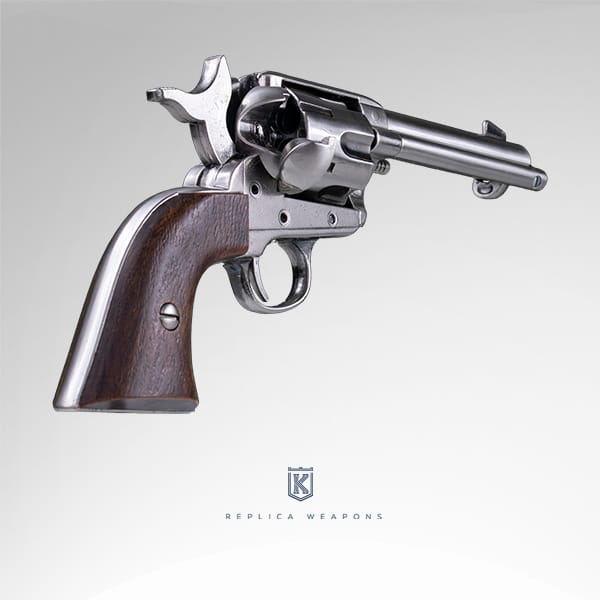
For admirers of the American frontier and classic cinema, the Peacemaker is a cornerstone of any Western collection. Its rotating cylinder and balanced ergonomics turned it into an unmistakable cultural icon. Adopted by the United States Army in 1873 in .45 Colt with a six-chamber cylinder, it was manufactured in various barrel lengths: 7.5 inches (19 cm) for the Cavalry model, 5.5 inches (14 cm) for Artillery, and 4.75 inches (12 cm) for the Civilian version.


Quick Comparison: Which Piece to Choose Based on Your Favorite Era
| Era | Starting Piece | Period | Key Historical Detail | Ideal For |
|---|---|---|---|---|
| Napoleonic Europe | Napoleon's flintlock pistol | Late 18th – early 19th century | Flintlock ignition; master gunsmiths such as Boutet | Classical desks and tabletop display cases |
| American Civil War | Colt Navy | 1851 | .36 caliber percussion cap-and-ball revolver | Collectors following the mechanical evolution of sidearms |
| Wild West (Western) | Peacemaker | 1873 | Colt Single Action Army, .45 Colt caliber, adopted by the U.S. Army | Western enthusiasts and classic cinema fans |
| Middle Ages | Charlemagne and Excalibur | Middle Ages and Arthurian legend | Swords tied to medieval historical tradition and legend | Wall panoplies and themed display halls |
Materials and Finishes: Zamak in Collector Weapons
A collector replica is appreciated for its visual presence, but equally for its tactile sensation: its weight, balance, and fine surface details.
At Kolser, we craft our replicas using zamak—a high-grade alloy of zinc, aluminum, magnesium, and copper that allows intricate reliefs, fine engravings, and historical proportions to be captured with precision, matching the weight and visual balance of original period firearms.
Safety in Collecting: The Difference with Airsoft Guns
Distinguishing between sporting replicas and collector display pieces is essential. While Airsoft guns are engineered to fire 6 mm projectiles for recreational sports, Kolser replicas are inert decorative items featuring working mechanical actions without any firing capacity.
Our pieces incorporate movable parts to recreate the tactile and visual handling experience, but completely lack functional barrels or projectile mechanics. Because replica legislation varies by country and category, we always recommend verifying local regulations prior to purchase, especially when shipping internationally or displaying at cultural events.
| Aspect | Kolser Decorative Replica | Airsoft Replica |
|---|---|---|
| Primary Purpose | Static display, collecting, theatre, and historical reenactment | Recreational sports and gaming |
| Firing Capability | Inert and simulated; no real firing capability | Fires 6 mm BB projectiles via spring, gas, or electric systems |
| Mechanisms | Working parts (hammer, cylinder, flintlock cock, trigger) without firing function | Functional firing and feeding mechanisms |
| Focus | Historical authenticity, craftsmanship, and aesthetics | Game performance, velocity, and field handling |
| Regulations | Varies by country and piece type; consult local statutes | Varies by jurisdiction; often subject to specific sports requirements |
How to Choose Your First Replica: Space, Theme, and Budget
Before making your decision, consider three practical factors:
- Theme: Begin with the period that fascinates you most; a cohesive collection delivers much greater visual impact than scattered, unrelated pieces.
- Space: Pistols and revolvers adapt effortlessly to a desk, bookshelf, or tabletop vitrine; swords require a wall mount or dedicated panoply.
- Budget: You can comfortably start with a single statement piece and gradually expand your display by era, region, or mechanical lineage.
Ideas for Displaying Your Kolser Historical Replicas at Home
The final step in enjoying your new acquisition is giving it the prominence it deserves. A flintlock pistol looks stunning on a dedicated wood stand atop an executive desk, while a pair of Western revolvers can be framed inside a wall-mounted display case or housed in a velvet-lined presentation box.
For swords, an elegant wall mount or heraldic panoply will transform any study into a veritable hall of honor. We recommend keeping your replicas away from high humidity and avoiding prolonged direct sunlight to preserve their finishes for years to come.

 EN
 ES
 FR
 DE
 IT